

 When I saw the headline in Forbes “Here’s Why Old Homes Suddenly Cost More Than New Ones,” I instantly thought I knew why. I love old homes; finally everyone agrees with me! The general public must now see the beauty of dated yet charming floor plans and the unique details of craftsmanship from another time. This is a lovely thought, but it’s entirely wrong. According to Forbes, there are a wide array of reasons that old homes cost more than new ones, and none of them have to do with aesthetics or a deep appreciation for history.
Existing homes are now selling for a median sale price of $441,500, about $40,000 more than new homes, which are selling for a median price of $401,800. The reasons for this are as fascinating as they are mysterious, and reveal a lot about how difficult real estate is to value. In fact, real estate is difficult to value even after you know what it sold for, since countless unseen costs often hide behind the final sale price.
It’s rare for old homes to sell for more than new ones. Over the last 690 months, the median old home has sold for more than the median new one only 22 times; that’s 22 months over almost sixty years. However, according to industry experts interviewed by Forbes, a new home situated next door to a comparable old home would still sell for more than the older home… the most accurate way to summarize this is to say “I’m confused.”
A primary reason for this strange situation is that builders currently are way more motivated to move their inventory than owners of existing homes, since many existing homeowners have extremely cheap 4% mortgages. On a basic level, this is a supply and demand issue; existing homeowners have less reason to sell, and builders have a massive inventory that they produced during the pandemic boom, and they need to get rid of this inventory like yesterday. To make it more difficult, they need to unload their inventory onto people who don’t want to pay 6.5% mortgage rates.
Basically, the average buyer would likely still prefer a new home if given the choice of a new one or a comparable old one. However, the sellers of new homes are far more motivated to sell than sellers of old homes.
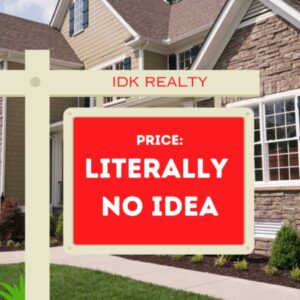
Though I believe that this conclusion is mostly accurate, it’s crucial to point out that the truth of these old vs. new home prices is literally impossible to find out with complete certainty, and it recently became even more impossible (who knew something could become even more impossible than impossible?).
As seasoned real estate licensees know, it’s difficult to ascertain the true sale value of one home compared to another. This is, of course, because both individual sellers and builders often use seller concessions, which can take many forms. A builder might offer to buy down the buyer’s interest rate, or they might offer free upgrades, like throwing in a free deck or hot tub. However, these incentives do not change the recorded sale price, so it doesn’t superficially look like the builder cut its price. A private seller of an existing home might also offer an interest rate buydown, or to pay for repairs, or other concessions, and these also wouldn’t superficially change the sale price.  It’s very difficult to find seller concession data on a large scale—it’s easier to find data on if the seller made any concessions, but not on the value of these concessions or what exactly they were. To find and aggregate this data, you’d have to individually call the agents involved in each transaction across the country… which sounds absolutely awful and/or expensive.
Though concessions are usually invisible in the sale price, it is clear that 60% of builders were offering some sort of concession(s) over the last few months, while 30% of builders were actually discounting their prices. It appears from Redfin data that about 40% sellers of existing homes have been offering concessions this year, though again, it’s not clear what exactly these were. Thus, it is probably meaningful overall that the median sale price of new homes has truly been much lower than that of old homes.
However, if you could prove that old home sellers have been paying an average of $45,000 in repairs for their buyers, which wouldn’t be reflected in the sale price, then perhaps this entire theory is wrong—perhaps old homes are in fact selling for less than new homes. I’m not saying that this is happening, but I’m saying that you can’t absolutely prove that it’s happening or not happening.
It used to be common that seller concessions would be listed in the MLS, but after the NAR commission lawsuits, most MLSs have eliminated the ability to list these concessions. Even before these lawsuits, the concessions weren’t always entered, but at least you could get an overall picture of concessions in your area from the MLS. This is no longer the case.
Sacramento appraiser Ryan Lundquist describes how much more difficult appraising is now that concessions aren’t listed in the MLS in his article “The Hot Mess of Concessions in Real Estate.” Though the title already says a lot, Lundquist also says “I’m not happy that concessions information is no longer instantly available… And let’s be real, how long are real estate agents expected to remember the property details when people are asking about concessions many months from now?”
It’s always been a good practice for appraisers to verify concession information on comps by calling the real estate agents who brokered the deal. However, Lundquist highlights how much more difficult this is now that almost no one writes it down in MLS data anymore. This means that how concessions affect market value is even more opaque than it was before. This also means that the real estate agent plays an absolutely crucial role here.
Real estate agents already provide essential local market insight. For example, in a recent article, I discussed how, in some markets in California, you don’t have a chance of getting a home if you don’t offer at least $600,000 over asking. This is crucial, local insight that a real estate agent would know, while others not in the industry might not. However, since commissions can no longer be advertised, and concessions are not in the MLS anymore, it’s increasingly important to use local real estate agents who can find out this information for you, whether you’re a buyer, seller, or an appraiser. Buyers need to know about concessions to know how much they should offer, and to give a clearer picture of their bargaining power. For example, in a market where sale prices seem fairly high, but sellers are offering a ton of concessions, that’s a clear sign that you might be able to submit a lowball offer. A good real estate agent can get you this information and advise you accordingly. On the other hand, if you have to offer a hundred thousand over asking to get a home, a real estate agent can save you trouble and narrow your search to something more realistic, even if sale prices seem superficially affordable.
Though the commission lawsuits have clarified some things for buyers, they have also made some things more cloudy, and have made local real estate agent expertise even more crucial. If you are an agent, it is always helpful to clearly define your value proposition as a crucial source of real market value information that is difficult to come by without a professional.
Each real estate transaction is unique, is subject to highly variable local market forces, and often contains a significant amount of information that is not publicly available. Despite the fact that more real estate activity is conducted online than ever before, it’s increasingly difficult to find crucial industry information to help in property valuation. This makes the expertise and market awareness of local agents essential for the average buyer or seller.
https://www.forbes.com/sites/brandonkochkodin/2025/08/27/heres-why-old-homes-suddenly-cost-more-than-shiny-new-ones/
https://sacramentoappraisalblog.com/2024/09/25/the-hot-mess-of-concessions-in-real-estate/#:~:text=It’s%20a%20bummer%20that%20so,or%20anticipation%20of%20future%20lawsuits.
The Sale Price is Meaningless